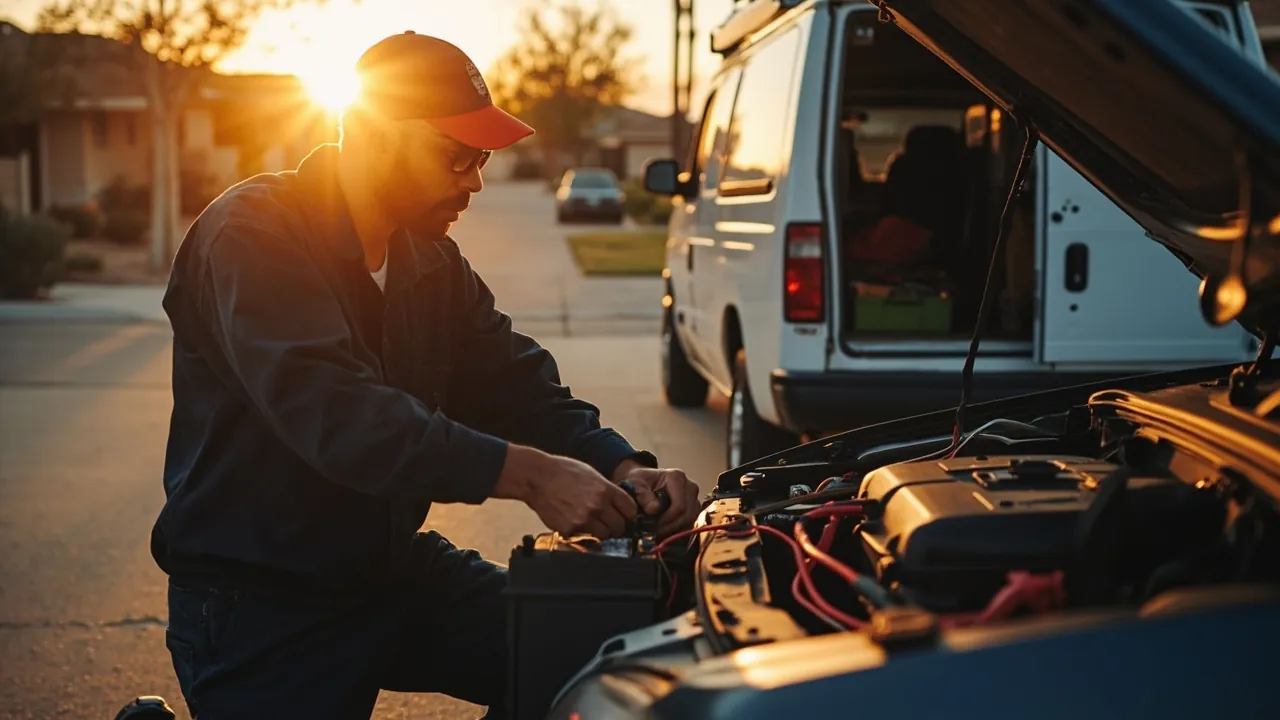
It's 6:47 AM on a Tuesday in Phoenix. Maria's car won't start in the driveway - she's already late for work, the kids need to be at school in 40 minutes, and the engine just clicks when she turns the key. She pulls up Google, types "mobile mechanic near me," and calls the first number with good reviews. It rings four times and goes to voicemail. She tries the second. Same thing. A third mobile mechanic picks up on the first ring, asks what kind of car, where it's parked, and when someone can be there. He's there by 7:45. The first two companies never knew she called.
That's the emergency-call problem in mobile auto repair. Most mobile mechanics don't lose jobs because their work is bad. They lose them because they can't answer the phone while they're halfway under a hood in someone's driveway. The customer has a dead battery at sunrise, a flat at the grocery store, or a check-engine light flashing on the highway. They don't leave voicemails. They tap the next number.
The U.S. mobile auto repair market is growing fast, fueled by the 280 million+ passenger vehicles on the road, increasingly complex in-car electronics, and a clear consumer preference for on-site service over dealership appointments. Grand View Research's mobile auto repair services report pegs the U.S. market at over $3 billion in 2025 with double-digit annual growth. The phone is the entire funnel. Let's walk through what a mobile mechanic's call flow looks like, why after-hours calls are the highest-value calls you can get, and what changes when an AI receptionist picks up.
What does a missed mobile mechanic call actually cost?
A lot more than the average ticket suggests. Three reasons:
1. The caller has a car problem right now. A mobile mechanic customer isn't shopping - they're stranded. The car is dead in a parking lot, won't start in the driveway, or making a noise on the highway. They've already committed to spending money today. Smith.ai's missed sales call research shows that 62% of callers who hit voicemail move to the next business within 10 minutes, and 80% never call the first company back. For mobile mechanics, that number is even higher - a stranded driver doesn't have the luxury of patience.
2. The first visit is just the start. A typical mobile mechanic visit runs $180-$450 for a battery, alternator, starter, or diagnostic. But the real revenue is the ongoing relationship - the same customer calls you for brakes next month, a timing belt service next season, and refers their neighbor when their neighbor's car makes the same clicking noise. BLS data on automotive service technicians and mobile repair industry benchmarks put average customer lifetime value between $1,800 and $4,200 depending on vehicle age and household size. The first call is just the entry point.
3. Battery-jump and lockout calls are all morning-edge. The single most profitable call type for a mobile mechanic - the dead battery or lockout at 6 AM - is also the one that gets answered least. The mechanic is asleep, the spouse is asleep, and the customer's phone call rings to voicemail at a time when every competitor is also unavailable. Whoever picks up first wins the job, plus the lifetime value of a customer who just discovered you're the one who got their car running.
Why do mobile mechanics miss so many calls?
Three structural problems stack up:
1. The mechanic is the dispatcher. A mobile mechanic operation usually runs with 1-4 techs. Whoever owns the business - or the lead tech - spends the morning driving between jobs, diagnosing cars in driveways, and ordering parts at the warehouse. They're not answering the phone because they're elbows-deep in someone else's engine bay. By the time they check voicemail mid-route, the urgent calls have already booked with the next mobile mechanic on Google.
2. The calls cluster around the worst possible times. Mobile mechanics get crushed in two windows: early morning (6-9 AM, the dead-battery / won't-start / commuter-stuck crowd) and after 5 PM (the post-work breakdown, the diagnostic question the customer has been putting off all day). NextPhone's analysis of 347,000 inbound calls across service businesses found that 28.5% of all calls arrive after hours - and for mobile mechanics, the after-hours skew is even more extreme because broken cars don't wait for business hours.
3. The callback window is brutal. Mobile auto repair is one of the most competitive Google Maps categories in any metro area. A driver with a dead battery calls three mobile mechanics and books the first one who can confirm a time. A 2-hour callback isn't late - it's too late. The driver is already in an Uber to work.
Citation capsule: The U.S. mobile auto repair market is valued at over $3 billion and growing at 11-12% annually, driven by rideshare drivers, fleet operators, and consumer demand for convenience, per Grand View Research's 2025 market report. There are roughly 7,000 mobile mechanic businesses in the U.S. - small operations, often owner-operator, where every missed call is a real revenue hit. Demand is high and growing. The question is whether you're the one answering when the engine won't turn over.
What changes when an AI receptionist picks up?
Let's walk through a real week at a one-truck mobile mechanic operation in Mesa. The owner, Devin, does all his own diagnostic and repair work out of a fully-stocked van. He averages about 35 calls a week, with a big spike Monday-Friday mornings. Before VoxPro: calls go to a generic voicemail when he's under a hood. He listens to voicemail during his afternoon windshield-time and tries to call people back. He estimates he books 8-10 jobs a week and knows he's losing several calls he never hears about.
After VoxPro: calls forward to the AI receptionist first. It picks up in under two rings, 24/7, and asks the right questions for a mobile mechanic: what's the year/make/model, what's the symptom (won't start, noise, warning light, lockout, flat), where is the vehicle parked (driveway, parking lot, workplace), and how urgent is it (right now vs. schedule for later in the week). It captures the lead and either texts Devin the dispatch info within 60 seconds or books the appointment directly into his calendar if it's during his open hours.
| Call type | What the AI does | Time to book |
|---|---|---|
| Stranded driver (won't start / lockout / flat) | Captures the vehicle, location, and urgency; texts Devin the dispatch details immediately; gives the caller a confirmed ETA window | Under 90 seconds |
| Diagnostic / check-engine light | Captures year/make/model and the exact symptoms; books a diagnostic slot or texts Devin the lead for a quote-back | Under 2 minutes |
| Scheduled service (brakes, timing belt, etc.) | Books the next available service slot in Devin's calendar, sends a confirmation text, texts Devin the job details | Under 2 minutes |
| Existing customer follow-up | Pulls the customer record, routes to Devin if available, otherwise takes a structured message and texts the customer a callback time | Under 90 seconds |
Notice what's not on that list: voicemail. The AI doesn't drop the caller into a mailbox - it engages, qualifies, captures, and books. If the customer explicitly asks for a human, the AI can warm-transfer to Devin mid-call, and if Devin can't pick up (because he's on a job), the AI takes a structured message with all the details Devin needs to call back and close.
This pattern translates directly from proven field-service data. ServiceTitan's case study on AI voice agents in field service shows an 80% booking rate as a frontline call taker with only a 30% escalation rate to a human. The mechanics aren't unique - a stranded driver needs their situation acknowledged, a time on the calendar, and a confirmation text. The AI does that in under two minutes, at any hour.
What is the real ROI for a mobile mechanic using AI?
Let's run the numbers, because this is where it stops being a feature list and becomes a budget conversation.
Devin's mobile mechanic operation was averaging 35 calls per week in spring 2026. Of those, roughly 14 were missed (a 40% miss rate, weighted heavily toward early morning and post-5 PM). After turning on VoxPro, the miss rate dropped to under 6% - the remaining misses are mostly spam and wrong numbers. That's roughly 11 additional answered-and-qualified calls per week.
| Metric | Before AI (April) | After AI (June) |
|---|---|---|
| Weekly inbound calls | 35 | 46 |
| Missed calls per week | 14 | 2-3 |
| One-time jobs per month | 22 | 51 |
| Average one-time ticket | $240 | $285 |
| Quote/booking rate per week | 9 | 29 |
| Repeat / referred customers per month | 5 | 14 |
| New monthly revenue from answered calls | - | +$8,400/month over baseline |
The cost of the AI: roughly $200-$280/month for a mobile mechanic operation's call volume, including bilingual support and 24/7 coverage. The math is straightforward. For every dollar Devin spent on AI receptionist coverage, he booked $30-$40 in additional monthly revenue in the first 30 days. The AI paid for itself before the end of week one.
And the lifetime value compounds. A mobile mechanic customer whose dead-battery call got answered at 6:47 AM, who got a tech to their driveway by 7:45, and whose car started on the first jump is a customer for life. They'll call you for brakes, alternators, diagnostics, and pre-purchase inspections. They'll tell their co-workers. The ROI isn't just the first $180 jump - it's the 3-year customer relationship that the voicemail was quietly losing to the mobile mechanic who picked up.
What should you do about missed mobile mechanic calls?
Three steps, in order of impact:
- Audit your current miss rate. Pull your phone logs for the last 30 days. Count inbound calls, answered calls, and voicemails. Most mobile mechanics are shocked to see the actual numbers - the missed morning calls add up fast. If your miss rate is above 20%, you're leaving real jobs on the table every week.
- Stop the voicemail bleed now. Every call that hits voicemail while you're under a hood is a stranded driver who is calling your competitor next. An AI receptionist picks up in under two rings, 24/7, qualifies the lead, and books the appointment - so you never lose another call to voicemail again. See VoxPro pricing and setup.
- Set up dispatch lead capture. Even the calls that don't book on the spot should be captured with vehicle, location, symptom, and urgency. Text the customer a confirmation immediately, and text yourself the dispatch details so you can follow up within the hour - between jobs, not at the end of the day. The AI does all of this automatically - no CRM setup, no spreadsheet, no phone tag.
The mobile mechanics that grow are the ones that answer the phone. Every missed call this week is a recurring customer you'll never get back. Get started with VoxPro and start capturing every dispatch call, day or night.
Sources
- Mobile Auto Repair Services Industry Report - Grand View Research, 2025.
- Finding the Best Solution to Stop Missing Sales Calls - Smith.ai, 2025.
- AI Receptionist Statistics: 347K Calls Analyzed - NextPhone, 2026.
- AI Voice Agent Case Study: Superior Plumbing - ServiceTitan, 2025.
- Automotive Service Technicians and Mechanics - U.S. Bureau of Labor Statistics, 2025.