Your phone rings at the main number. The caller needs an emergency HVAC repair in Plano, speaks Spanish, and has already tried the Dallas location. A basic phone tree asks the caller to guess which department to choose. A useful routing system asks a few natural questions, checks which team can help, and moves the call to the right destination.
That distinction matters once a business has more than one branch, service area, or specialized team. The hard part is no longer answering the phone. It is deciding where the conversation should go without making the caller repeat everything.
What multi-location call routing actually does
Multi-location call routing applies business rules to an incoming call before it reaches a branch or employee. Those rules can use the number the customer dialed, the caller's ZIP code, the requested service, preferred language, business hours, team availability, or a combination of those signals.
The routing engine should also have escalation and fallback rules. Twilio describes skills-based routing as a system that matches tasks to workers while maintaining escalation and fallback logic.1 The same principle works for a three-location salon group, a regional HVAC company, or a dental organization with several clinics.
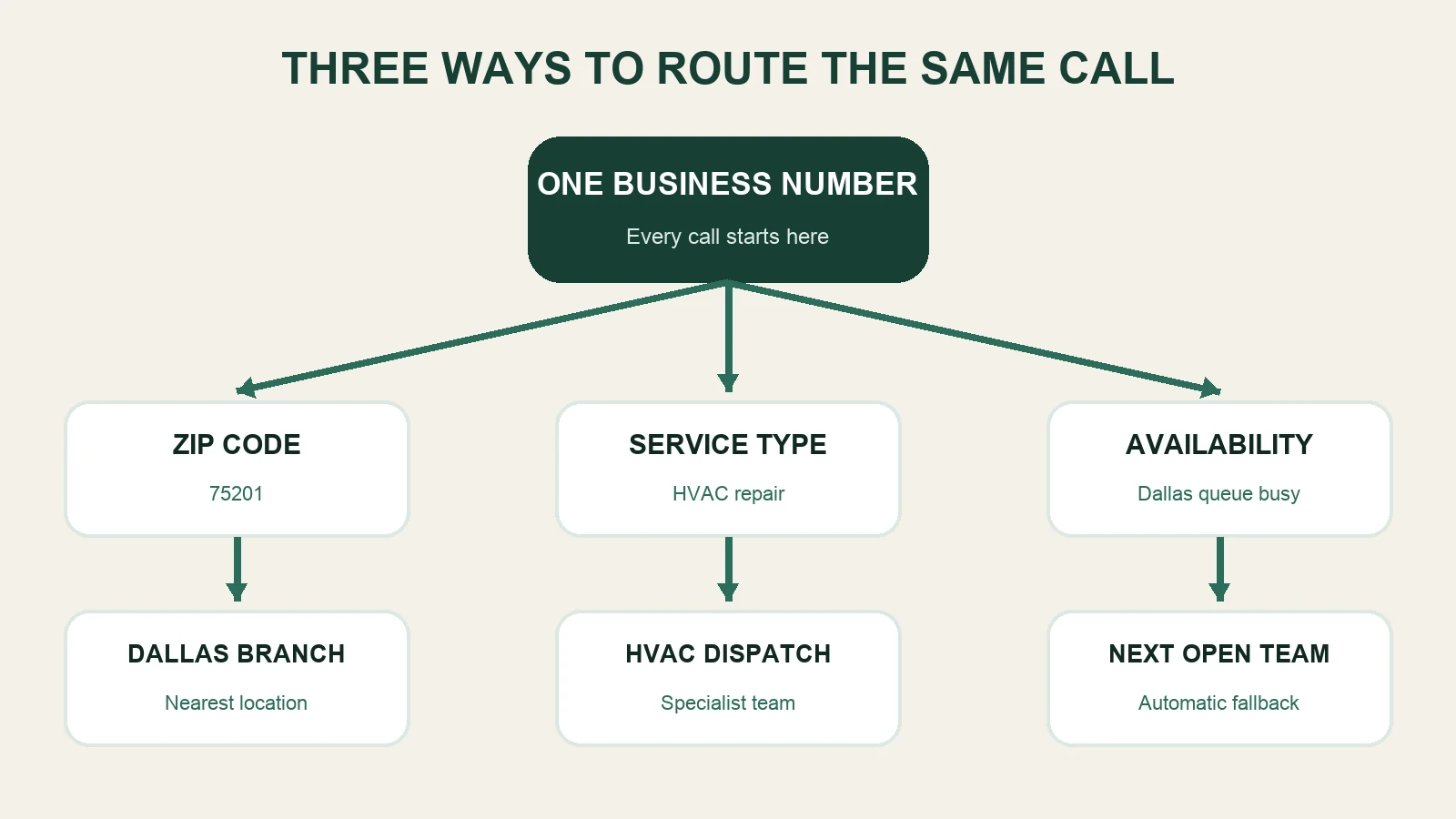
A routing rule is not the same as a long interactive voice response menu. A menu says, "Press one for sales, press two for service." A routing conversation can ask, "What can we help you with today?" and classify the answer. The customer speaks normally while the system does the sorting.
The five routing signals that matter most
1. The location number the customer called
Each branch can keep its own local number while sharing one answering workflow. This is useful because Google says a Business Profile should provide a phone number that connects to the individual business location.2 A caller who taps the number on the Plano profile can be tagged as a Plano inquiry before anyone says a word.
You do not have to replace established phone numbers to centralize call handling. The FCC explains that numbers can often be ported between wireline, IP, and wireless providers when the business remains in the same geographic area.3 Porting is one option; call forwarding can be another. The right choice depends on the current carrier and how much control the business needs.
2. ZIP code or service address
For home-service companies, the caller's address is often more useful than the caller's phone area code. Mobile numbers move with people, families keep old numbers, and business owners travel. Ask for the service ZIP code or street address, then map it to the territory your teams actually cover.
Be precise about the rule. "Nearest branch" sounds simple, but the closest office may not serve that neighborhood. An assigned service territory is safer: ZIP codes 75023 through 75025 go to Plano; 75201 through 75209 go to Dallas; edge cases go to central dispatch.
3. Service type
A customer asking for commercial installation should not land in residential maintenance. A dental emergency should not wait behind routine cleaning requests. Service-based routing sends the call to the team with the right schedule, pricing rules, intake questions, and authority.
This is where natural-language intake earns its keep. The receptionist can collect the problem, urgency, property type, and account status before transferring the call. The receiving employee starts with context instead of asking the customer to tell the story again.
4. Language
Language should be detected early, but it should not trap the caller in a separate system. The routing flow can continue in English or Spanish, collect the same required details, and then book or transfer according to the same service rules.
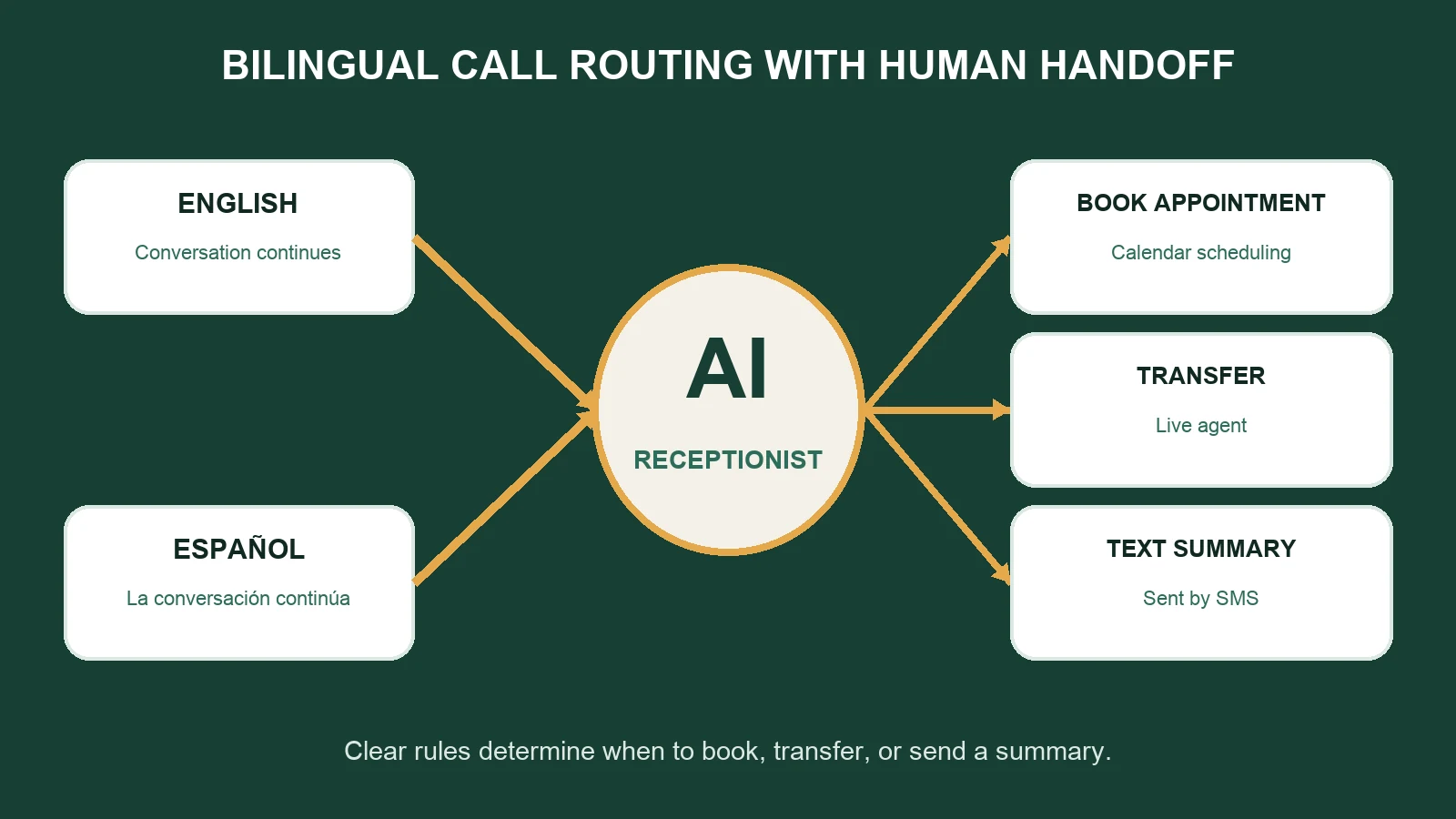
If the call needs a human, route it to someone who can continue in that language. If no bilingual teammate is available, use an agreed fallback: collect the details, set an expectation, send the transcript or summary to the responsible branch, and schedule a callback. Do not pretend a live transfer succeeded when it did not.
5. Availability and time of day
A branch-specific rule should never end at an unattended phone. Build a sequence: primary branch, overflow team, central receptionist, on-call person, then message and callback. Each step needs a timeout and a clear final action.
Availability routing can also protect the customer experience during spikes. If one branch has six callers waiting while another trained team is free, overflow rules can balance the load. The routing system does not need to ignore location. It simply knows when availability should outrank location.
A practical routing matrix
| Caller signal | Primary destination | Fallback |
|---|---|---|
| Called Dallas local number | Dallas front desk | Central team |
| Plano service ZIP code | Plano dispatch | Next available North Texas team |
| Commercial installation | Commercial sales | Qualified estimator callback |
| Spanish-speaking caller | Bilingual queue | Spanish callback workflow |
| Emergency after hours | On-call technician | Escalation manager |
Start with a small matrix like this before adding complex rules. If two rules conflict, decide which one wins. An emergency may outrank geography. A language need may outrank the branch the customer originally called. An existing customer with an open job may route directly to the assigned coordinator.
Then test the collision cases, not just the happy path. What happens when a Spanish-speaking caller needs after-hours service outside the normal territory? What happens when the assigned branch is open but its queue is full? What happens when an existing customer calls a different branch number? Write the expected destination for each scenario before configuring the system. Those answers become the acceptance tests for the routing flow and prevent staff from making different decisions under pressure.
One number or separate local numbers?
Both models can work. A single public number is easier to remember and useful for advertising across a region. Separate local numbers preserve local identity and can improve attribution because you know which branch listing, campaign, or page produced the call.
The better design is often a hybrid: keep a local number for each branch and feed every number into one routing layer. The caller sees a local presence. The business gets consistent answering, shared coverage, and centralized reporting.
The customer should experience one competent company, even when the call crosses branch lines behind the scenes.
What a good human handoff includes
A transfer is not successful just because the phone rang somewhere else. The receiving person should get the caller's name, callback number, location, requested service, urgency, language, and a short summary. Warm transfer rules should also tell the caller what is happening.
- Tell the caller where the call is going. "I am connecting you with our Plano service team."
- Pass the context. The team should see the intake details before answering.
- Set a timeout. Do not let the caller ring forever.
- Return to a useful fallback. Offer booking, a scheduled callback, or message capture.
- Send a confirmation. Text the appointment, callback window, or case details when appropriate.
Common routing mistakes
Routing by area code alone
Area codes are weak location signals. Use the service address, branch number dialed, or a direct question instead.
Building rules around the org chart
Customers know their problem, not your department names. Ask about the problem first, then map it internally.
No overflow plan
A perfect branch match that rings unanswered is still a lost call. Every route needs a next step.
Too many questions before action
Collect only what changes the destination or enables the next step. If the answer will not affect routing, booking, safety, or the handoff, ask it later.
No audit trail
Track which number was called, which rules fired, where the call landed, whether it was answered, and what happened next. Without that record, managers cannot tell whether a branch has a staffing problem or a routing problem.
How to design the first version
- Inventory every public number. Include branch listings, ads, websites, directories, and old forwarding numbers.
- List the destinations. Branch desks, service queues, sales teams, on-call staff, and escalation managers.
- Define the minimum intake. Name, callback number, service location, need, urgency, and language.
- Write the priority rules. Decide what wins when location, service, language, and availability point in different directions.
- Add fallbacks. Specify timeout, overflow, callback, and after-hours behavior for every destination.
- Test real scenarios. Call as a new lead, existing customer, Spanish speaker, emergency caller, and out-of-area prospect.
VoxPro can sit in front of this workflow, answer in English or Spanish, collect the routing signals, book when the rules allow it, and hand off when a person is the right next step. For larger or distributed operations, see the enterprise call-handling options. If you want to compare the cost against staffing every branch, review VoxPro pricing.
The goal is not more routing. It is less friction.
The best multi-location call system is almost invisible. Customers explain what they need once. The right branch receives useful context. Busy teams have overflow coverage. Managers can see where calls are going and where they are failing.
Start with the few rules that change outcomes: service area, request type, language, availability, and urgency. Then test the edges. A simple, explicit routing plan beats a complicated phone tree that nobody understands.
Sources
- TaskRouter: Skills-based routing for contact centers - Twilio.
- Guidelines for representing your business on Google - Google Business Profile Help.
- Porting: Keeping Your Phone Number When You Change Providers - Federal Communications Commission, reviewed December 10, 2025.