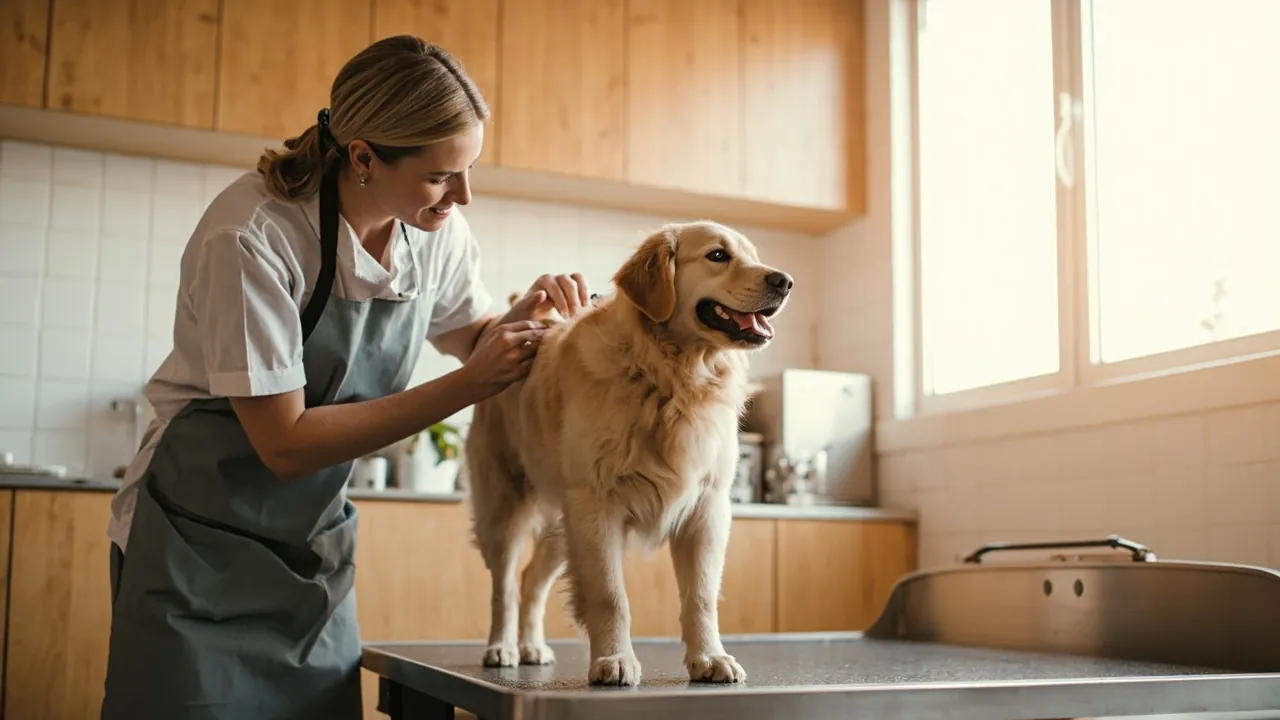
A dog owner in Austin calls her groomer at 7:40 AM on a Saturday. Her goldendoodle needs a bath and full groom before the in-laws arrive that afternoon. The groomer is elbow-deep in suds on the first dog of the day. The phone rings once, twice, three times, then rolls to voicemail. The caller hangs up after four rings without leaving a message. She calls the next shop on Google and books there before 8 AM.
That single missed call is worth about $95 to the original groomer - the average full-groom price for a medium dog - plus the repeat visits every 6 to 8 weeks for the life of the pet. Pet grooming is one of the stickiest recurring-service businesses in the country, and most of it still runs on a one-line voicemail that nobody checks between 9 AM and 5 PM.
Pet grooming and vet clinics miss calls at extraordinary rates. The businesses are usually one or two people running a shop floor. The phone is the bottleneck. If the bather is mid-suds, the groomer is shearing, or the front desk is checking in a patient, no one is going to pick up. The call rolls to voicemail. The caller calls the next shop. The original business never knows it lost the customer.
Why pet grooming and vet clinics miss so many calls
The math is brutal. A typical mobile or shop-based groomer takes 8 to 14 dogs a day. Each appointment runs 60 to 120 minutes. During that window, the groomer cannot stop what they are doing to answer a call - a half-finished groom with a wiggly dog is not safe to walk away from. Vet clinics have a similar problem with exam rooms and procedures in progress.
Meanwhile, pet owners call constantly. According to the American Pet Products Association, 70% of U.S. households own a pet, and dog grooming appointments are scheduled on a 4-12 week cadence depending on the breed. A single two-groomer shop with 200 active canine clients will receive 15-30 calls a day just from existing customers trying to rebook, plus another wave of new-customer quote calls every weekend.
Industry research from Smith.ai puts the average small-business miss rate at 27% during business hours and 100% after hours. Pet grooming sits well above that average because the work is hands-on the entire day - there is no natural break to grab the phone.
The after-hours emergency problem
Pet owners do not stop worrying about their animals at 5 PM. A dog that ate something it should not have at 6:30 PM, a cat that the owner thinks is in labor at 10 PM, a boarded pet that the family cannot pick up until late - these are real calls, often urgent, and they almost never reach a human at a typical vet or groomer.
Most clinics refer after-hours calls to an emergency animal hospital. That referral should be fast and warm - "Here is the number for the BluePearl on Oak Lawn, they are open until midnight and they have your dog's records." Instead it is usually just a voicemail that says "leave a message and we will call you back tomorrow." The owner is already in the car and panicking. They Google the nearest 24-hour vet and drive there.
What a missed grooming call actually costs
Let's run the numbers on a single missed new-customer call.
| Item | Value |
|---|---|
| Average full groom (medium dog) | $85 - $130 |
| Average nail trim / bath only | $35 - $55 |
| Repeat cadence | Every 6 - 8 weeks |
| Annual revenue per customer | $650 - $1,050 |
| Customer lifespan (active pet) | 5 - 10 years |
| Lifetime customer value | $3,250 - $10,500 |
A single missed call on a Saturday morning is not a $95 transaction. It is a customer relationship worth $3,000 to $10,000 over the life of the pet - and the pet owner almost never switches groomers once they have a good one. Per industry grooming data, customer churn at established grooming shops runs below 10% per year, mostly because customers dread the search for a new groomer more than they mind the price.
For vet clinics the math is even more dramatic. Per the AVMA, the average annual spend per dog on vet care is $580, and per cat $430. A new-client household that lands at your clinic for the first wellness visit typically stays 7-10 years. One missed call from a new puppy owner is potentially $4,000 to $6,000 of lifetime revenue.
The booking pattern most grooming shops miss
Pet grooming has a wave pattern that almost nobody staffs for. According to ServiceTitan's call booking data, residential service businesses see 40-50% of inbound calls cluster into a 4-hour window. For groomers that window is 8 AM to noon on weekdays and 8 AM to 2 PM on Saturdays. That is when the shop floor is busiest, the groomers are heads-down, and the phones ring the most.
Weekday afternoons are dead by comparison. Tuesday at 2 PM might get 3 calls; Tuesday at 9:30 AM might get 12. The asymmetry is real. But the owner cannot hire a second groomer just for Saturday mornings - the rest of the week there is not enough work. And hiring a full-time receptionist to sit at a desk for 30 hours a week, half of which is quiet, does not pencil out at most shop sizes.
What an AI receptionist does for a grooming shop or vet clinic
An AI receptionist picks up every call within two rings, 24/7, in the shop's voice. For a grooming shop the call flow usually looks like this:
- Caller dials. AI answers with the shop's name and a warm greeting ("Thanks for calling Wags & Whiskers, this is Maya, how can I help?").
- Identify the need. Full groom, bath, nail trim, or a question about pricing and availability.
- Pull the schedule. The AI checks the shop's live calendar in real time and offers the next 2-3 openings that match the requested service and dog size.
- Book and confirm. Captures name, dog's name and breed, phone, and any notes (anxious dog, matting, vet referral). Sends a confirmation text to the owner immediately and a notification to the groomer.
- Handle the after-hours calls. Books the appointment for the next business day, captures urgent concerns, and routes genuine emergencies (a dog that just ate chocolate) to the nearest 24-hour vet.
The owner and groomers keep working. The phone stops being a bottleneck. The customer gets an answer in under 30 seconds and a booked appointment with a confirmation text.
What about vet clinics with clinical urgency triage?
Vet clinics have a wrinkle grooming shops do not: medical triage. Not every call is a booking. Some are urgent. The AI needs to recognize the difference and route accordingly.
A working triage flow for a vet clinic sounds like this:
- Routine booking (wellness exam, vaccines, dental cleaning, grooming add-on) - AI offers the next 2-3 available slots, books the appointment, confirms by text.
- Symptom call (limping, not eating, minor ear issue) - AI captures details, marks the call as "needs callback within 2 hours," and texts the on-call tech or vet to review and respond.
- Urgent or emergency (hit by car, suspected toxin, labored breathing, labor complications) - AI immediately gives the caller the nearest 24-hour emergency hospital address and phone, stays on the line until they confirm they are driving there, and pages the clinic owner as a backup.
The third bucket is the one that protects the practice legally and reputationally. Pet owners in an emergency do not want voicemail - they want a number to call and directions to drive. An AI that recognizes the trigger phrases and responds in under 10 seconds is materially better than a voicemail box that says "leave a message."
What does it cost to lose 10 calls a week?
Let's be conservative. A two-groomer shop misses 10 calls a week - 6 during business hours because the groomers cannot stop, 4 after hours. Of those 10 missed calls:
- 3 are new-customer quote calls. At a 40% conversion rate, that's roughly 1 new customer booked per week. At $85 average groom and 6 visits a year for 5 years, that one customer is worth $2,550 in lifetime revenue.
- 4 are existing customers trying to rebook. Even with a 60% rebook rate (people leave voicemails and the shop calls back), losing 40% of those means 1.6 lost rebookings per week. That is about $7,000 in lost annual grooming revenue.
- 3 are after-hours calls that go nowhere - either to voicemail or to a competitor. Most are non-urgent bookings that could have been captured automatically for the next business day.
Total revenue lost per week from 10 missed calls: roughly $9,500 over the next 12 months. Per year, close to $500,000 of potential lifetime value walking out the door because nobody picked up the phone.
At VoxPro's pricing tier for a single shop number, the AI receptionist costs a small fraction of that lost revenue. See VoxPro pricing and setup.
What should you do about missed grooming or vet calls?
Three steps, in order of impact:
- Audit your real miss rate. Pull your phone logs for the last 30 days. Count inbound calls, calls answered by a human, calls that hit voicemail, and calls that hung up before leaving a message. Most grooming shop owners are shocked - the actual numbers are usually 25-40% during business hours and 100% after hours.
- Stop the call bleed with 24/7 coverage. Every call that hits voicemail during business hours is a customer who is about to call your competitor. An AI receptionist picks up in under two rings, qualifies the call, books the appointment, and sends a confirmation - so the groomer never has to stop mid-bath to grab the phone. See VoxPro pricing and setup.
- Triage after-hours calls properly. For vet clinics especially, set up clear rules for what the AI does with urgent or emergency calls - emergency hospital routing, on-call paging, same-day booking for routine concerns. For grooming shops, an after-hours booking flow for the next business day captures most of what would otherwise be lost.
The pet care businesses that grow are the ones that answer the phone every time. Every missed call this week is a multi-year customer relationship handed to the shop down the road. Get started with VoxPro and stop losing grooming and vet calls to voicemail.
Sources
- APPA National Pet Owners Survey - American Pet Products Association, 2025.
- Finding the Best Solution to Stop Missing Sales Calls - Smith.ai, 2025.
- Call Booking Rates Data for Residential Service Businesses - ServiceTitan, 2025.
- Pet Grooming Industry Statistics - Petsitter.com, 2025.
- AVMA Pet Ownership and Demographics Sourcebook - American Veterinary Medical Association, 2025.
- Animal Caretakers and Veterinary Assistants Occupational Employment - U.S. Bureau of Labor Statistics, 2025.