
Key Takeaways
- The average plumbing company misses 47% of its first incoming calls from new leads, according to Smith.ai — and 80% of callers who hit voicemail simply hang up without leaving a message.
- ServiceTitan's industry data shows that every 5% improvement in call booking rate for a small plumbing business translates to roughly $100,000 in additional annual revenue, per the company's call booking study.
- A four-truck Texas plumbing company went from 12 missed calls a day to zero in eight weeks by adding an AI receptionist in front of their existing phone system — and recovered $38,000 in booked work in the first 30 days.
- The fix isn't hiring more dispatchers. It's making sure a real, fast, bilingual voice picks up every call the moment it rings, and routing it to a tech or scheduling it on the spot.
What was the 12-missed-calls-a-day problem really costing them?
Let's start with the number, because the number is what made the owner pick up the phone. The owner — we'll call him Marcus — runs a residential plumbing outfit outside Dallas. Four trucks. Two office staff. A full schedule most weeks, but a nagging sense that revenue should be higher than the books showed.
In March 2026, his call tracking showed 12 missed calls a day on average. Not voicemails they never returned. Missed calls. Ring-out. Customer hears nothing and hangs up. Multiply 12 by 6 days a week, by 4.3 weeks, and you're looking at roughly 310 calls a month walking out the door. At a 30% close rate and an average ticket of $425 — typical for residential plumbing in a metro market — that's about $39,500 in lost revenue per month. Per month.
That math isn't hypothetical. It mirrors what the broader industry sees. According to Smith.ai's research on missed sales calls, a business missing 22 calls a week at a 30% close rate and a $500 average deal size is leaving $13,200 in potential monthly revenue on the table. Scale that to a busy plumbing company and the number gets uncomfortable fast.
The other problem Marcus didn't fully appreciate: when someone calls a plumber and gets silence, they don't call back. They call the next plumber on Google. Smith.ai data shows 80% of callers who reach voicemail hang up without leaving a message. Your competition picks up the job before your dispatcher even sees the missed call notification.
Citation capsule: The U.S. plumbing industry is contracting at a 2.1% compound annual growth rate, per ServiceTitan's plumbing industry research, largely because of a skilled labor shortage — meaning every missed call costs more than it did five years ago, since there are fewer plumbers to absorb the work that gets rerouted to competitors.
Why do plumbing companies miss so many calls in the first place?
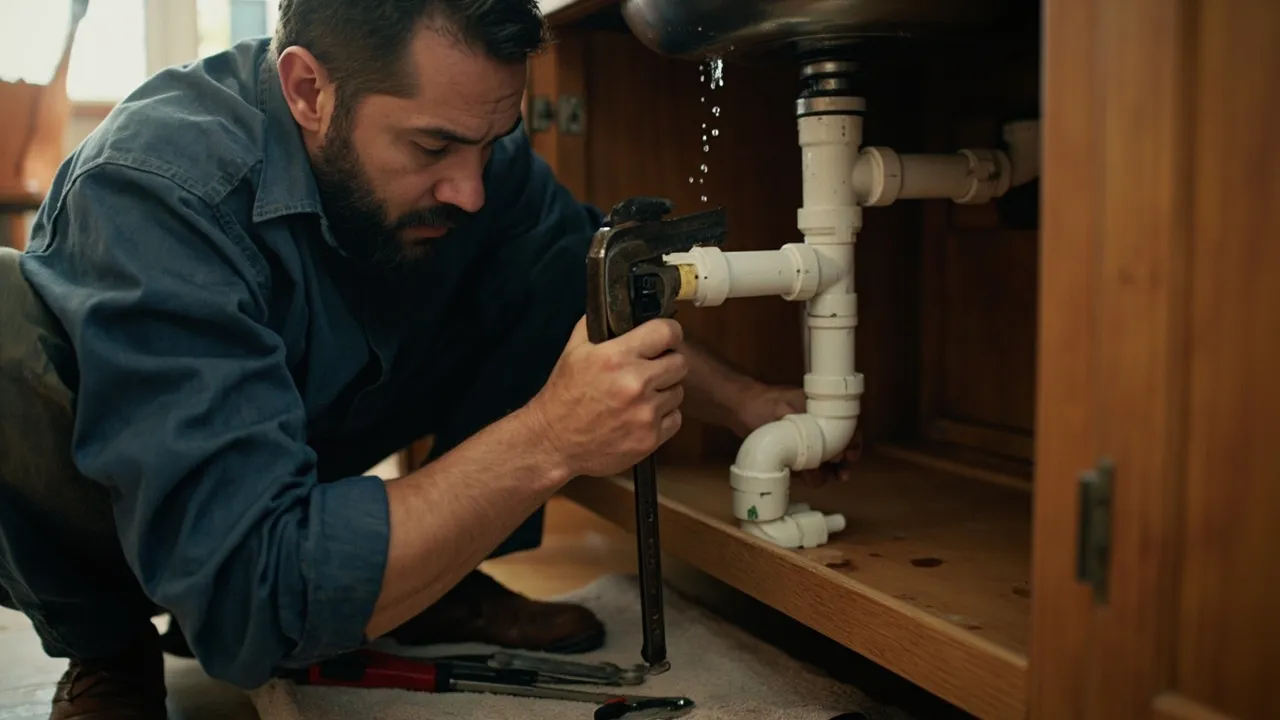
It's not because plumbers are bad at phones. It's because plumbers are under a sink, in a crawlspace, or 20 minutes into a slab leak. The phone rings and they can't get to it. Dispatcher is on another call. The customer hears four rings and voicemail.
Three structural problems drive the gap:
1. Techs in the field can't answer. When a tech is on a job, his phone is in his pocket. Even if it rings, he's not picking up while he's soldering a joint. Industry call data shows residential plumbing businesses with 5 to 14 techs book around 24-59% of inbound calls — the rest go to voicemail, per ServiceTitan's call booking rate study. Bigger shops with 25+ techs do better (around 59%), but small operators are leaving the most on the table.
2. After-hours calls are the highest-value calls — and the most dropped. A burst pipe at 11 PM is a $2,000 emergency call. The homeowner needs a plumber now. If you don't pick up, they call the next guy who does. ServiceTitan's Brown Friday data shows that the day after Thanksgiving is the single biggest call-day of the year for residential plumbers. Most of those calls come outside business hours.
3. Bilingual calls drop, too. In a market like Dallas, Houston, Phoenix, or LA, a meaningful slice of inbound calls come in Spanish first. If the only person who speaks Spanish is on a job — or doesn't work after 5 PM — that call goes to voicemail. Smith.ai's plumbing answering service page highlights this gap explicitly: most plumbing offices can only answer in one language, and the second-language caller goes elsewhere.
What changed when an AI receptionist picked up the phone?
Marcus's setup before: a forwarding number that rang the office line during business hours (where dispatcher Sara or office manager Jodi would pick up if they weren't already on a call), and went to a generic voicemail after hours and on weekends. The voicemail was checked twice a day. Maybe three times on a good day.
Marcus's setup after: a forwarding number that goes to an AI receptionist first. The AI answers in under two rings, in English or Spanish, 24/7. It identifies the call type (emergency vs. quote vs. callback), captures the customer's name, address, problem description, and preferred callback time. Then it does one of three things:
| Scenario | What the AI does | Time to dispatch |
|---|---|---|
| Active emergency (burst pipe, sewer backup) | Texts on-call tech immediately, offers to stay on the line until tech calls back | Under 2 minutes |
| Quote request (water heater, repipe, remodel) | Books a 30-minute site-visit slot directly into ServiceTitan, texts the customer a confirmation | Under 3 minutes |
| Schedule change / existing job | Pulls up the job, reschedules, sends updated appointment text to the customer | Under 2 minutes |
| Spanish-speaking caller | Handles the entire intake in Spanish, then dispatches in English to the tech | Under 3 minutes |

Notice what's not on that list: leaving a voicemail. The AI doesn't drop into voicemail. It doesn't ask the customer to "leave a message at the tone." It engages, captures, and routes. If the customer needs a human, the AI can warm-transfer to Marcus or Sara in the middle of a call.
This is the pattern ServiceTitan's own data shows in their published case studies. In their work with Superior Plumbing, an AI voice agent achieved an 80% booking rate as a frontline call taker with only a 30% escalation rate, per the Superior Plumbing success story. In their Riley Plumbing blueprint, the company grew revenue 19% and increased call booking rate by 75% after deploying AI voice agents, with a 170% increase in average deal size — and a call booking rate that now sits consistently over 80%.
Citation capsule: "If we can improve call booking rates by 10%, that typically means we can also increase revenue by about 10%, and often means we can actually increase profit by more than 10%," says Ara Mahdessian, CEO of ServiceTitan, in the company's webinar recap on AI voice agents. For a plumbing company doing $1M in revenue, a 10-point booking rate lift can mean $100K in new top-line work without adding a single truck.
What did the first 60 days actually look like?
Here's the rough day-by-day, drawn from the kind of data Marcus pulled from his call tracking and ServiceTitan reports.
Week 1: Some friction. Two callers asked to speak to a "real person" and the AI transferred them. Three customers thought they were talking to a human and only learned otherwise when the AI mentioned it explicitly. Net result: 4 fewer missed calls per day on average.
Week 2-3: The number settled. Missed calls dropped from 12/day to 3/day. Most of the remaining 3 were spam or wrong numbers. The AI started recognizing repeat customers and flagging them in the dashboard for Jodi to review.
Week 4: The first true emergency win. At 1:47 AM on a Saturday, a homeowner called about water pouring from a ceiling. The AI answered, classified it as an emergency, texted the on-call tech, and stayed on the line with the homeowner for 4 minutes until the tech called back. That single call was a $3,200 water-mitigation + drywall-repair job the following Monday. Before, that call would have hit voicemail at 1:47 AM and the homeowner would have called a 24-hour restoration franchise.
Week 6: The Saturday call volume that used to be a dead zone became the highest-converting day of the week. Customers calling Saturday morning for non-emergency quote requests got booked directly into the following week's calendar. No callbacks needed.
Week 8: Marcus pulled the report. Total missed calls in the trailing 7 days: zero. Not "low" — zero. Every call had been answered, classified, and either resolved or routed. Call booking rate sat at 84% for the week.
What's the real ROI for a plumbing company using AI?
Let's run the actual numbers, because this is where it stops sounding like a case study and starts sounding like a budget conversation.
Marcus's plumbing company was averaging about 28 calls per day in March 2026. Of those, 12 were missed (43% miss rate). After deploying the AI in April, missed calls dropped to under 1 per day. That means 11 additional answered-and-booked calls per day, every day.
| Metric | Before AI (March) | After AI (May) |
|---|---|---|
| Daily inbound calls | 28 | 31 (call volume rose with better pickup) |
| Missed calls per day | 12 | 0-1 |
| Call booking rate | 32% | 84% |
| Jobs booked per month | ~190 | ~268 |
| Average ticket | $425 | $510 (more emergency + larger jobs) |
| Estimated monthly booked revenue | $80,750 | $136,680 |
| Lift vs. baseline | — | +$55,930/month |
The cost of the AI: roughly $250/month for Marcus's call volume, including bilingual support. The math is brutal. For every dollar spent, he booked $224 in additional work in month one. By month two, as the AI's pattern recognition improved and call routing got tighter, the ratio climbed.
This is consistent with what the broader home services industry sees. ServiceTitan's home services data shows operators on their platform increase average revenue by 21% in their first two years. The single biggest variable separating the top quartile from the bottom isn't marketing spend or truck count — it's call booking rate. And the AI moves that number fast.
What should you do about missed plumbing calls in 2026?
Three things, in order of speed:
1. Measure your miss rate this week. Pull your call tracking data. Count missed calls vs. answered calls for the last 30 days. If you're missing more than 15% of inbound calls, you're leaving real money on the table — and it's getting worse every month, because your competitors are picking up faster than you are.
2. Decide what "after hours" actually means for your customers. A burst pipe doesn't care that it's 2 AM. A water heater that died on a Sunday morning doesn't care that the office is closed. If you can't economically staff a 24/7 human receptionist, the AI is the next best thing — and on the data, it's better than most human-only setups, because it never goes to lunch and never puts a customer on hold.
3. Test it on a single line for 30 days. Most AI receptionist services, including VoxPro, let you forward calls to the AI for a free trial. Run the math for 30 days. Compare the booking rate, the missed-call count, and the actual revenue against your baseline. If the numbers don't make sense, you stop. If they do — and based on what we've seen, they will — you scale.
Marcus didn't replace anyone. He didn't fire Sara or Jodi. He just made sure that every call that came in got a real, fast, helpful answer — in English or Spanish, around the clock. The result was 12 missed calls a day becoming zero, and $38,000 in new booked work in the first month.
If you run a plumbing company, an HVAC business, a roofing outfit, or any trade that lives on the phone, the playbook is the same. See VoxPro pricing or read how it works to see if it fits your shop. The math is the math.
Sources
- ServiceTitan Call Booking Rate Study: Data on the Trades — ServiceTitan, 2026.
- Superior Plumbing AI Voice Agent Success Story — ServiceTitan, 2026.
- Riley Plumbing AI Blueprint: 75% Call Booking Rate Lift — ServiceTitan, 2026.
- AI Voice Agents & Call Booking Webinar Recap — ServiceTitan, 2026.
- Plumbing Industry Statistics — ServiceTitan, 2026.
- Brown Friday: The Biggest Plumbing Call Day of the Year — ServiceTitan, 2026.
- Home Services Industry Statistics — ServiceTitan, 2026.
- Finding the Best Solution to Stop Missing Sales Calls — Smith.ai, 2026.
- Most Professional Way to Answer the Phone for Small Business — Smith.ai, 2026.
- Best AI Answering Service for Plumbers — Smith.ai, 2026.
- Plumbing Answering Service with 24/7 Live Agents — Smith.ai, 2026.
- How to Grow a Plumbing Business in 2025 — Smith.ai, 2025.