
AI receptionists are good at repeatable work: answering common questions, capturing contact details, booking approved appointment types, routing by service area, and sending confirmations. Trouble starts when a business treats that list as permission to automate every conversation.
The better question is not, “Can AI answer this call?” It is, “Should AI finish this call?” For some conversations, the right job is to identify the situation, collect only the necessary context, and hand the caller to a person.
The rule: automate the routine, escalate the consequential
A call should move to a human when the next response could materially affect someone’s safety, money, legal position, medical care, relationship with the business, or willingness to remain a customer. That does not make the AI useless. It makes the AI the first layer of a safer call flow.
The NIST AI Risk Management Framework emphasizes managing AI risk through governance, measurement, and ongoing management rather than assuming one control fits every situation.[1] For a phone system, that means defining the moments when automation stops and accountable human judgment begins.
1. Immediate danger or an active emergency
If a caller reports fire, smoke, a gas smell, a violent threat, a medical emergency, a person trapped, or another immediate danger, the AI should not troubleshoot beyond an approved safety script. It should tell the caller to contact 911 or the appropriate emergency service, then notify the on-call person if the business has a role after emergency responders are contacted.
The system should never imply that a callback is a substitute for emergency help. The handoff rule should be based on clear phrases and context, with a fallback that treats uncertainty as urgent.
2. Threats, self-harm, harassment, or violence
These calls need a person trained to follow the company’s safety and escalation policy. The AI can capture a callback number and alert the designated manager, but it should not improvise counseling, investigate a threat, or promise an outcome.
Define who receives the alert, what information is included, and what happens if that person does not answer. A handoff rule without an after-hours fallback is only a label.
3. Medical, legal, or financial advice
An AI receptionist can schedule a consultation, collect a short reason for the call, and share approved office information. It should not diagnose symptoms, interpret a legal situation, recommend a financial decision, or speak as if it is the licensed professional.
Healthcare businesses also need to review how vendors handle protected health information. The U.S. Department of Health and Human Services explains that covered entities need appropriate contracts and safeguards when a business associate handles protected health information.[2] The safe pattern is narrow intake, approved disclosures, and a human handoff for professional judgment.

4. Angry customers and cancellation threats
Automation can recognize negative language, but a customer saying “I am frustrated” is not the same as a customer explaining why a crew missed an appointment for the third time. The second call needs authority, empathy, and the ability to make a real decision.
Transfer when the caller asks for a manager, threatens to cancel, disputes the company’s version of events, repeats the same complaint, or uses language that signals the relationship is at risk. The human should receive the customer’s name, account or job reference, a short summary, and what the caller already told the AI.
5. Refunds, credits, discounts, and negotiation
An AI can explain a published policy. It should not invent a refund, negotiate a price, waive a fee, or offer compensation beyond a rule the business has explicitly authorized.
Set limits in plain terms. For example: the AI may confirm that a refund request was received, but refunds above a defined amount go to a manager. A caller asking for a standard estimate can stay in the normal flow. A caller disputing completed work or demanding a chargeback should reach a person.
6. Repeated misunderstanding or low confidence
The most frustrating automation failure is a loop: the caller explains, the system guesses wrong, and the caller repeats the same answer. After two failed attempts to understand the intent, address, name, or requested service, the AI should stop retrying and transfer.
Low-confidence handoff is not a failure metric. It is a quality feature. The transfer message should be direct: “I want to make sure we get this right. I am bringing in a team member.”
7. Complex or unusually valuable opportunities
Some callers are not emergencies, but they are too important for a standard script. Examples include a commercial property manager asking about fifty locations, a general contractor requesting a large bid, a wedding venue inquiry for a premium date, or a referral partner proposing ongoing work.
The AI can qualify the opportunity and route it to the correct owner. It should not flatten a high-value conversation into a generic appointment slot when a salesperson or manager can shape the deal.
8. The caller asks for a human or needs another communication method
If the caller asks for a person, the system should honor the request without forcing another round of questions. It may ask for a name and a one-sentence reason so the handoff reaches the right team, but it should not make access to a person feel like a hidden menu option.
Businesses also need a plan for callers who use relay services, have speech or hearing disabilities, speak in a way the system repeatedly misreads, or need another effective communication method. The U.S. Department of Justice guidance on effective communication explains that covered businesses must communicate effectively with people who have communication disabilities and provide appropriate aids or services when needed.[3]
A practical handoff matrix
| Call type | AI’s role | Human action |
|---|---|---|
| Emergency or danger | Approved safety instruction, collect minimal context, alert | Respond after emergency services are contacted |
| Complaint or cancellation | Identify customer and summarize the issue | Listen, decide, and recover the relationship |
| Medical, legal, or financial question | Schedule and collect limited intake | Provide licensed or professional judgment |
| Refund or negotiation | Explain approved policy | Authorize exceptions or compensation |
| Repeated misunderstanding | Stop after the defined retry limit | Continue with full context |
| Large opportunity | Qualify and route | Own the sales conversation |
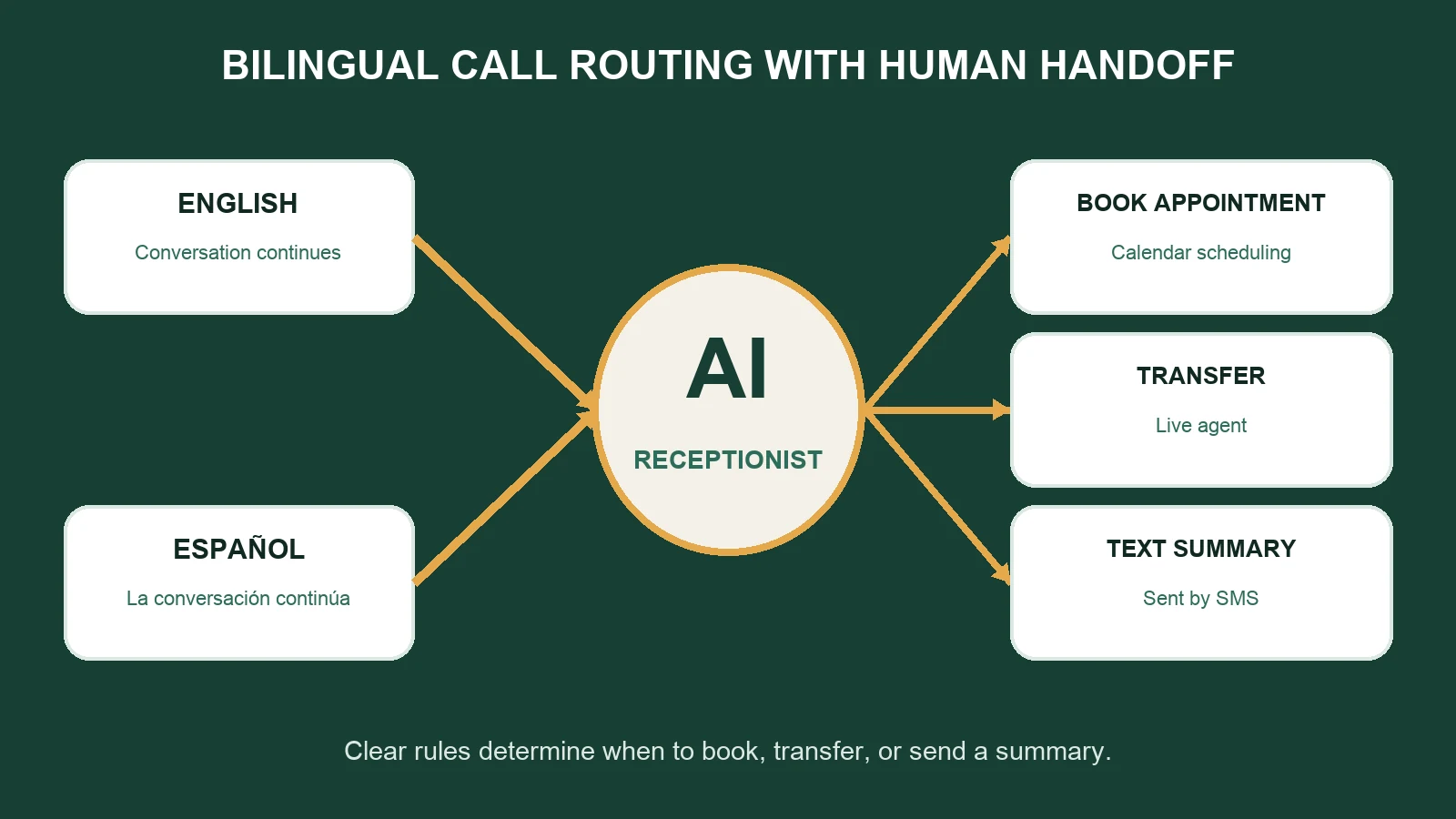
What the human should receive with the transfer
A warm transfer is only useful if the customer does not have to begin again. Send the receiving person:
- Caller name, number, and company or account
- The caller’s intent in one sentence
- The urgency level and the phrase that triggered escalation
- Answers already collected
- Any appointment, job, invoice, or location connected to the call
- Whether the caller requested a manager or specific employee
If a live transfer is unavailable, give the caller an honest expectation. Say who will respond and when. Do not promise “someone will call right back” unless the business has a response-time rule and a backup person.
How to test the handoff before launch
Do not test only the happy path. Call the system with scenarios that should force it to stop:
- Report smoke and ask whether to wait for a technician.
- Say you want to cancel after a bad service visit.
- Ask for legal, medical, or financial advice.
- Give an unclear address twice.
- Ask for a human immediately.
- Request a refund above the approved limit.
- Describe a large multi-location opportunity.
- Call after hours when the primary manager does not answer.
Review the transcript, transfer time, summary quality, and fallback behavior. The Federal Trade Commission’s AI enforcement guidance is a useful reminder not to make claims that the system cannot reliably deliver.[4] A trustworthy phone workflow is specific about what automation does and where people remain responsible.
The best AI receptionist is not trying to replace judgment
The strongest setup lets AI remove repetitive work while protecting the conversations that need authority, empathy, or professional expertise. Routine callers get fast answers. Sensitive callers reach a person. Staff receive cleaner context instead of raw missed-call notifications.
That is the practical standard: automate what is predictable, measure what is uncertain, and transfer before the customer pays for the system’s limits.
Sources
- Artificial Intelligence Risk Management Framework: Generative Artificial Intelligence Profile - National Institute of Standards and Technology, 2024.
- Business Associates - U.S. Department of Health and Human Services.
- ADA Requirements: Effective Communication - U.S. Department of Justice.
- Operation AI Comply: continuing the crackdown on overpromises and AI-related lies - Federal Trade Commission, 2024.