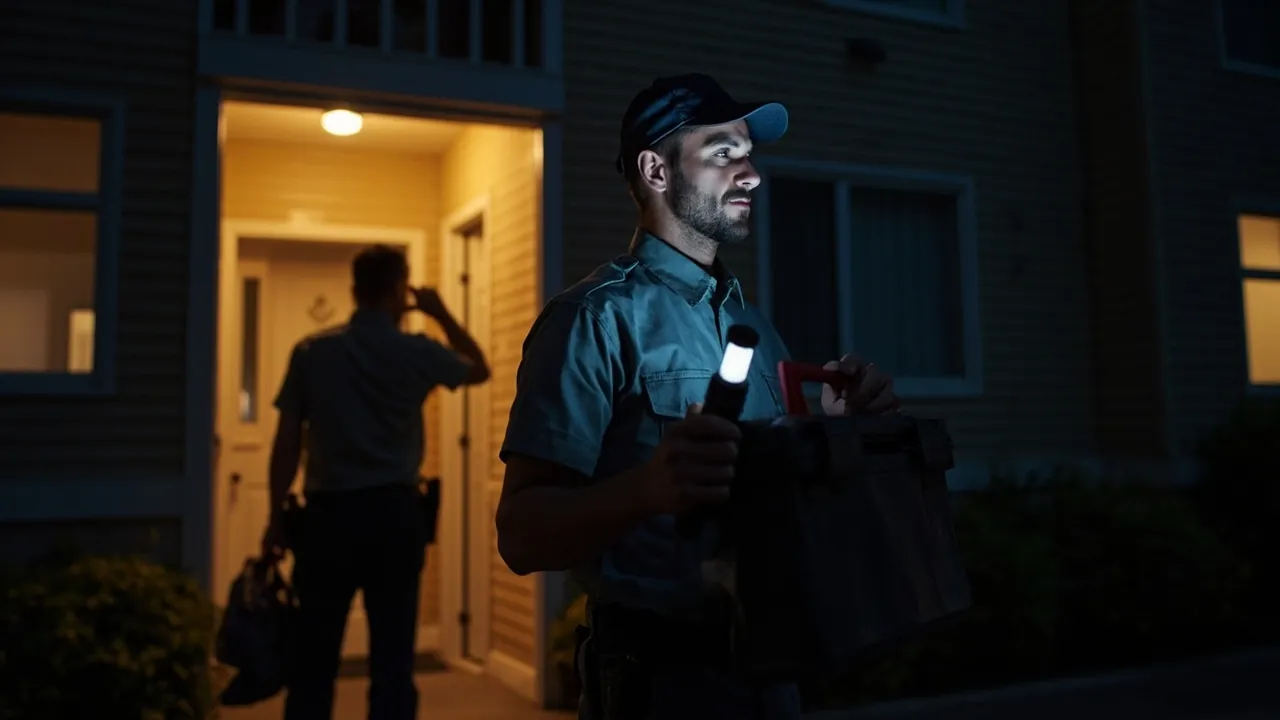
A burst pipe at 11:40 PM. A lockout at 2 AM. An AC failure in July while the family is asleep. These are not hypothetical scenarios. For a property manager overseeing 50 to 300 units, midnight emergency calls are a weekly occurrence, and they are the single most important calls your phone will ring for. Miss one and you do not just lose a tenant. You lose a renewal, a referral, and possibly a liability case.
Most property management companies cannot justify a 24/7 dispatcher at $4,000 to $6,000 per month, and most answering services charge by the minute and miss the nuance of "is this a leak, a lockout, or a lease question?" That is the gap an AI receptionist fills. It answers every call at any hour, asks the right triage questions, and routes only the emergencies that need a human on the line.
Why property managers lose tenant calls at night
The economics of a property management office are unforgiving. Leasing teams are stretched thin, on-site managers are often handling a walkthrough or a move-out inspection, and the after-hours coverage typically falls on the property manager's personal cell phone. That cell phone is not always answered. Sometimes it is on silent. Sometimes the manager is in a closing. Sometimes the call is from a number the manager does not recognize, and the manager lets it ring through.
According to call tracking data from over 2,000 small businesses analyzed by NextPhone, 28.5% of inbound calls arrive after business hours when no one is available to pick up. The same study found that 78% of callers who reach voicemail do not leave a message. For a property manager, that 78% is not just a missed call. It is a tenant who is now Googling "property manager near me" at midnight.
Then there is the language problem. Roughly 8% of inbound business calls come in Spanish, and another 1.7% in French or another language. Most property management offices are not staffed bilingually after 5 PM. The caller hangs up. The next agent who answers in Spanish gets the lease.

The actual cost of missing a tenant emergency
Let us put real numbers on it. The standard property management portfolio ranges from 50 to 300 doors, and a typical manager loses between 30% and 50% of incoming tenant calls to voicemail, busy signals, or unreturned messages. That is a portfolio of 100 units generating roughly 30 to 60 calls per week. Half of them missed means 15 to 30 calls a week going to a black hole.
What is each call worth?
- Resident retention is the single biggest line item. Replacing a tenant costs $2,500 to $5,000 in turnover (cleaning, paint, marketing, vacancy). One missed midnight call that pushes a frustrated tenant to move out at lease end is $4,000 in avoidable cost.
- An emergency that is mishandled is worse. A water leak that goes unreported for 8 hours can cause $10,000 to $40,000 in property damage. The insurance carrier will ask: "Did the tenant reach you?" The answer is usually, "Yes, but it went to voicemail."
- Vendor coordination and lease renewals account for a third of incoming calls. Each is worth $150 to $600 in management fees over the year.
Across a typical 100-door portfolio, the realistic lost revenue from missed calls is between $25,000 and $80,000 per year. The number sounds high until you multiply 30 missed calls a week by the average value of a retained tenant, an avoided emergency, and a closed vendor job.
What kinds of calls come in at midnight
Not every after-hours call is an emergency. The mistake most property managers make is treating every call as either a full-blown crisis or something that can wait until Monday. The truth is more granular.
| Call type | What the caller actually needs | How fast it needs to be routed |
|---|---|---|
| Water leak / flood / no hot water | Tenant needs a plumber dispatched tonight | Immediate: text on-call vendor, confirm ETA with tenant |
| Lockout | Tenant is locked out, possibly with kids or a pet | Immediate: connect to 24/7 locksmith vendor |
| No heat in winter / no AC in summer | Habitability issue, often legally urgent | Within 30 minutes: dispatch HVAC vendor, log work order |
| Noise complaint from neighbor | Tenant wants intervention, not a call back at 9 AM | Same night: log complaint, text property manager |
| Package / access question | Tenant wants to know if a delivery was received | Next business day: text details in the morning |
| Lease renewal / new rental inquiry | Prospect or current tenant with money on the line | Next business day: capture details, schedule callback |
| Existing vendor / contractor | Wants to confirm work order, schedule, or invoice | Log and email summary, no call back needed |
An AI receptionist that has been configured for property management can sort these in real time. The first three rows trigger a vendor dispatch and a text to the on-call manager. The fourth gets logged with a callback window. The bottom three get captured cleanly and surfaced in the morning queue. No tenant is left waiting. No manager is woken up for a noise complaint that can wait.
The before-and-after call flow
Before an AI receptionist, the midnight call flow looks like this: tenant calls, gets voicemail, leaves a partial message, hangs up, calls back, gets voicemail again, gives up, files a complaint on Google. The property manager wakes up to three missed calls, a one-star review, and a possible habitability claim. The whole chain cost $0 in software and $4,000 in damage.
After VoxPro, the same call flow looks different. The tenant calls at 11:47 PM. The AI answers in under a second, identifies itself as the property management assistant, and asks: "Is this an emergency that needs someone out tonight, or can I take a message for the office in the morning?" If the caller says emergency, the AI asks the triage questions: address, unit number, type of issue, is anyone in danger, is water actively leaking. It then texts the on-call vendor with the details, texts the property manager a one-line summary, and confirms with the tenant: "Your plumber Mike is on the way. He will be there within 45 minutes." The tenant hangs up relieved. The manager wakes up to one text, not three missed calls and a crisis.
Practical example: A tenant in unit 204 calls at 12:14 AM reporting water coming through the kitchen ceiling. VoxPro captures the address, unit, that a child is in the unit, that water is actively dripping onto the stove, and that the upstairs neighbor is not answering. It texts the on-call plumber with the unit and the situation, texts the property manager "Possible upstairs overflow, unit 204 has child present, dispatching plumber now," and tells the tenant to shut off water under the sink if safe. The plumber arrives at 12:45 AM. The upstairs unit is fine; the issue was a clogged drain, not a burst pipe. Damage is contained to a $200 cleanup. The tenant renews. The manager slept through most of it.

What an AI receptionist actually handles on a property management line
A good property management AI receptionist is not a generic call center script. It knows the difference between a tenant calling about a lease and a vendor calling about an invoice. It knows that a noise complaint at 1 AM is logged differently than a water leak. It knows when to dispatch, when to log, and when to wake someone up.
For a tenant, VoxPro can capture name, unit, callback number, type of issue, urgency, and whether anyone is in danger. It can text the on-call vendor, schedule a follow-up, send a confirmation, and email a clean summary to the property manager. It can also offer the tenant a callback window during business hours if the issue is not an emergency.
For a prospect calling about a vacancy, VoxPro can capture name, contact info, desired move-in date, number of bedrooms, budget, and whether they have pets. It can offer a showing window and text the leasing agent: "Prospect, 2BR, May 15 move-in, two cats, budget $1,800-$2,100." The leasing agent calls back the next morning with a real appointment, not a mystery number.
For a vendor, VoxPro can route by service type. Plumbing calls go to the on-call plumber. HVAC goes to the HVAC vendor. Landscaping and pest control calls get logged for the next business day. The vendor gets a work order number, the property manager gets a one-line summary, and the on-call vendor's phone stops ringing for jobs that are not theirs.
For an existing tenant with a non-emergency, VoxPro captures the request, logs it in the maintenance queue, and texts the tenant a work order number. The property manager picks it up in the morning. No missed call. No black hole.
Why this is not just another answering service
Traditional answering services can take a message, but property management calls need structured intake. "Someone called about a leak" is not enough. You need the unit, the severity, whether water is active, whether anyone is in danger, and which vendor to dispatch. Per-minute answering services also get expensive when call volume spikes. EverHelp's 2026 answering service pricing guide shows traditional services often price by the minute, with overages for after-hours and bilingual coverage. That pricing model is backwards for property managers, because the busiest weeks are also the weeks when every call matters most.
VoxPro is built for the outcome, not the message. Triage the call. Dispatch the right vendor. Confirm with the tenant. Log the work order. Text the manager. Keep the property manager focused on the renewals, the showings, and the portfolio work that actually requires a human.
How to set this up without making the property feel like a call center
Start with the five call paths that cover most of your portfolio:
- Tenant emergency: water, lockout, no heat, no AC, gas smell, fire alarm.
- Tenant non-emergency: maintenance request, package question, lease question, rent question.
- Prospect inquiry: vacancy availability, showing request, application status.
- Vendor: work order status, dispatch confirmation, invoice or payment question.
- Wrong number, solicitation, or after-hours noise complaint.
Then write the dispatch rules. Which plumber is on call this week. Which locksmith covers which zip code. Which HVAC vendor responds to no-AC calls in summer. The AI should know who to text, when to text them, and what the resident needs to hear in the meantime. The on-call manager should get a one-line text per emergency, not a full transcript at 2 AM.
Finally, test it during the hours you currently miss the most calls: 10 PM to 7 AM, weekends, holidays, and during the first week of the month when rent calls spike. Judge it by whether the right vendor gets dispatched, whether the tenant gets a confirmation, and whether the manager wakes up to a queue that is sorted, not a phone full of red badges and no information.
The property manager still matters. The midnight call does not have to.
Property management is a relationship business. Tenants renew with the manager they trust, not the answering service that took their call. VoxPro does not replace the relationship. It protects the moment before the relationship can be used. When the plumber arrives on time, when the lockout is handled without a two-hour wait, when the prospect gets a showing the next morning instead of a callback in three days, that is when the property manager earns the renewal.
If you are already good at retaining tenants once you hear from them, the fastest lever may be simpler than a new marketing channel: stop letting midnight calls hit voicemail. See VoxPro pricing or read how it works to decide whether 24/7 tenant call coverage belongs on your property management line this month.
Sources
- AI Receptionist Statistics: 347K Calls Analyzed - NextPhone, 2026.
- Answering Service Pricing in 2026 - EverHelp, 2026.
- Quick Real Estate Statistics - National Association of REALTORS, 2026.
- Property, Real Estate, and Community Association Managers - U.S. Bureau of Labor Statistics, 2025.